It is happening on estimate calls across the country: the homeowner pulls out their phone and says, "ChatGPT says this should cost half that." Contractors in online forums are asking each other how to handle it, and the answers range from patient to furious.
This guide is for owners who want to keep the job, keep the relationship, and use the moment. It isn't legal or pricing advice. It covers what we've seen contractors discuss in public, what the research says about how homeowners shop, and a few scripts you can adapt.
What contractors are saying
We couldn't find formal data on how often this happens, so treat these as signals, not statistics:
- Contractors on the Jobber community forum have asked each other, "How are you handling AI-generated advice from clients?"
- On the Mike Holt electrical forum, contractors discussed "Using ChatGPT for estimating". The common view there: it's a useful checker for your own numbers, but you shouldn't submit a bid based on it.
- A June 2026 roofing podcast episode ran three real roof estimates through ChatGPT, Claude and Gemini to see what homeowners might be told.
- A secondhand report on a Painting Contractors Association test said ChatGPT's price for one cabinet-refinishing job was far below the contractor dataset average. We haven't verified the original.
The pattern is consistent: AI gives a generic number, and your estimate is a specific number for one house.
Why ChatGPT's number and yours differ
A chatbot typically doesn't know:
- The condition of the job: rot under the shingles, a second layer to tear off, a roof that is steeper than average, an old panel that must be replaced first.
- Your local costs: labor, permits, disposal, supplier prices this month.
- What's included: warranty terms, cleanup, licensed and insured crews, who is liable if something goes wrong.
- What the homeowner didn't say: access, HOA rules, timing, materials.
None of that means the homeowner is wrong to ask. It means the comparison is apples to oranges.
How to respond in the moment
Stay calm and curious. The customer is telling you they care about price, which is useful.
- Ask to see it. "Can I take a look at what it said?" Reading the assumptions usually shows the gap (square footage, materials, no tear-off).
- Agree where it's right. If a range is reasonable, say so. It builds trust.
- Explain the difference in plain terms. "That figure assumes X. Your roof has Y, and here's what that adds."
- Show the line items. A written estimate with materials, labor, permits, disposal and warranty is easier to defend than a single number.
- Offer a simple comparison. "If you get other quotes, ask each one what's included: tear-off, underlayment, permits, cleanup, warranty."
- Don't attack the tool. Saying "ChatGPT is useless" makes you look defensive. Saying "it's a good starting point, here's what it can't see" makes you look expert.
A sample line you can adapt:
"I'm glad you checked. A tool like that gives a general range, but it can't see your roof. Here's what's different about yours, and here's what each part of my price covers. If you get other quotes, I'd compare what's included."
Prevent the argument: put your pricing logic on your website
Homeowners are shopping before they call. A 2026 roofing homeowner survey found 65% were more likely to call a roofer whose website lists pricing, down from 78% the year before, and 66% said they would gather three quotes (Roofing Contractor). The sample size wasn't stated, and the survey skewed older, but the direction is useful: homeowners compare.
You don't need to publish a fixed price. Consider a page that explains:
- What typically drives the price of your most common jobs.
- A realistic range for a typical job in your area, with the caveats that move it up or down. Only publish figures you can stand behind.
- What's included in your estimate, and what isn't.
- How long the job takes, what a free inspection covers, and your warranty.
This helps customers, and a plain-language page like this is also the type of content that AI tools can read and quote. If ChatGPT is going to describe your service, it helps if your own page says it accurately. See our guide for roofers, HVAC and plumbers.
Check what ChatGPT says about you
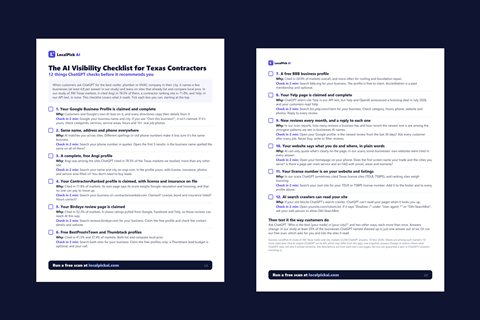
Customers may ask ChatGPT not just "what should this cost?" but also "who should I call?" Look at what it recommends in your area and which sites it reads. In our November 2026 study of 390 Texas markets, ChatGPT's citations went mostly to ranking sites and marketplaces such as Angi and ContractorsRanked, so the reviews and details on those sites can shape what a homeowner hears. Our five-minute test shows you how to check: how to check if ChatGPT recommends your business. You can also look at the public page for your trade and city, such as roofing in Dallas.
Turn the moment into a process
- Add a line to your estimate template: "This estimate is for [address] based on [inspection findings]. General online price ranges do not include site conditions."
- Train whoever answers the phone to say: "Happy to give a free inspection so the number is for your house, not an average."
- Keep a short list of the most common reasons your price differs from generic ranges and use it in follow-up emails.
- Collect reviews that mention honest pricing and clear estimates. Customers like to read them, and they're a real answer to "is this person fair?" See how many reviews and how recent.
What not to do
- Don't match a chatbot's number just to win the job. If the scope is real, price it for the real scope.
- Don't hide the breakdown. Opaque prices invite comparisons with a generic number.
- Don't copy AI estimates into your bids without checking them. Treat any AI figure as a draft to verify, as the Mike Holt forum thread's contractors advise.
- Don't promise results from AI visibility work. Nobody can guarantee what an AI tool tells people.
FAQ
Should I use ChatGPT to help me write estimates? Many contractors use it for drafting and checking. Always review the numbers against your own costs and local requirements.
Is it worth publishing price ranges? It's a judgment call. The survey above suggests pricing information makes calls somewhat more likely, but a bad range can hurt you. Explain the factors, and keep ranges honest.
What if the homeowner wants to hire whoever ChatGPT recommends? Then it matters what ChatGPT says about you. Check, and fix the sources it reads.
See what ChatGPT says about your company. Run a free scan at localpickai.com. You'll see whether ChatGPT names you, who it names instead, which websites it read, and what to fix first. Free, no signup, about a minute.