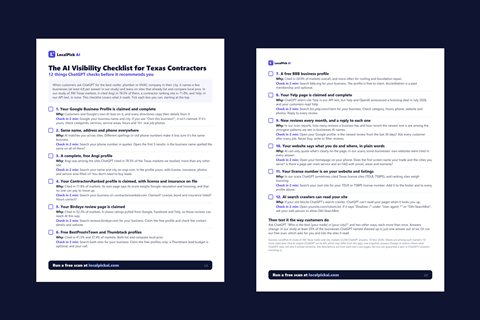
Search for "ChatGPT for roofing," "ChatGPT for plumbing business" or "ChatGPT for HVAC" and you'll find a lot of people trying to work out how to use it. Contractors are using AI for emails, estimates and marketing. Some save real time. Others get burned.
This guide covers what surveys say about contractors' AI use, the everyday uses that tend to work, the mistakes to avoid, and one check owners often forget: what customers see when they ask ChatGPT about you. It doesn't endorse any product, and it isn't legal or tax advice.
How many contractors use AI?
It depends on who you ask, which is a reason to be careful with big numbers:
- ServiceTitan's 2026 Residential State of the Trades (more than 1,000 residential specialty contractors, including HVAC) found 25% use AI. Among non-users, 53% cited complexity or not knowing where to start, 43% lack of trust in outputs, 32% data security and privacy, and 29% cost (ACHR News).
- Houzz's 2026 State of AI in Construction and Design (601 US construction and design businesses, fielded June to July 2026) found 52% use AI-powered tools, up 20 points from 2025. Among those, sales and marketing (64%) and project and client management (59%) were common, and estimates and proposals were the top project use (87% of those using AI for project work). Users reported saving 4.7 hours a week on average, which is self-reported (Roofing Contractor).
The surveys differ in who they asked and how they define AI use. Whatever the true number, it's clearly rising.
Everyday uses that tend to be safe
Check everything before it goes out under your name.
| Task | How AI can help | What to check |
|---|---|---|
| Review replies | Draft a polite, specific reply to a review | Facts, names, tone; never share private details |
| Emails and follow-ups | Draft quote follow-ups, appointment reminders | Prices, dates, promises |
| Service page and FAQ drafts | First drafts from your notes | Accuracy, local details, license and warranty facts |
| Job descriptions and photo captions | Turn notes into a clear paragraph | Accuracy |
| Checklists and scripts | Phone scripts, inspection checklists | That they fit your process |
| Proposals | Tidy formatting and language | Every number and scope item |
| Summaries | Summarize long manuals, warranty terms | Against the original document |
Uses to be careful with
- Pricing and estimates. Contractors on forums describe ChatGPT as useful for checking their own numbers but not as a source for bids. One electrical forum thread's consensus: don't submit a bid based on it (Mike Holt forum). It doesn't see the job.
- Technical or code advice. Wrong answers sound confident. Check manufacturer documents and your local code.
- Legal and insurance language. Have a professional review contracts, warranties and anything about insurance claims. Texas has specific rules about waiving deductibles and contractors acting as adjusters.
- Anything you couldn't defend if a customer asked "where did this come from?"
Mistakes to avoid
- Pasting private customer information (names, addresses, phone numbers, photos of people's homes with identifying details) into a tool without knowing how it's stored. Check the tool's data settings, and keep customer data out unless you've confirmed it's handled properly.
- Letting it write fake reviews or testimonials. That's against platform rules and the FTC's 2024 rule.
- Publishing unchecked text. Made-up details (a service you don't offer, a license you don't hold) can hurt you.
- Copying text that sounds like everyone else's. Add your real details, jobs and voice.
- Over-trusting a confident tone.
- Letting AI send customer messages with no review.
The check most owners forget
While you're using ChatGPT to help your business, your customers may be using it to evaluate you. Spend five minutes asking it the questions they'd ask:
- "Who is the best [your trade] in [your city]?"
- "Can you recommend a good [your trade] in [your city]? Give me a short list."
- "What are the top-rated options for a [your trade] in [your city]?"
- "What's the phone number for [your business]?"
- "How much does [your most common job] cost in [your city]?"
Ask each at least twice, in a fresh chat. Write down whether you're named, what it says about you, and which websites it cites. See the five-minute test and why answers differ.
What you might find:
- You aren't named. Look at who is, and which sites it read. In our November 2026 study of 390 Texas markets, ChatGPT cited Angi in 78.5% of markets and ContractorsRanked in 71.8%. See the directories ChatGPT reads.
- It gets facts wrong. An old phone number, wrong hours, services you don't offer. See what to do if ChatGPT shows the wrong phone number.
- It gives a generic price. See publishing prices and what to do when customers show you a ChatGPT estimate.
- It's fine. Great. Check again next month.
A simple way to start
| Week | Task |
|---|---|
| 1 | Pick one low-risk use, such as drafting review replies or FAQ answers, and use AI only as a first draft |
| 2 | Write down your rules: what you never paste in, who reviews outputs |
| 3 | Run the five-minute check on yourself and log results |
| 4 | Decide what's worth keeping; ask your team what they've found |
FAQ
Is ChatGPT free for business use? There are free and paid plans. Check the current terms and data settings of whatever tool you use.
Will using ChatGPT make it recommend me? No. Using a tool and being recommended by it are unrelated.
Should I worry that my competitors use AI? Use it where it saves you time, and don't copy text. Your real jobs and reviews are what no tool can produce for you.
Check what ChatGPT says about your company. Run a free scan at localpickai.com. You'll see whether ChatGPT names you, who it names instead, which websites it read, and what to fix first. Free, no signup, about a minute.